Decide Like They're Watching: Why Your Team Reverse Engineers Every Call You Make
It is the end of a long day. Something has gone completely wrong. A deal collapsed, an agent gave notice, a problem landed on your desk that needs an answer right now. You can feel the pull to decide — fast, certain, alone in your head. So you decide. And it feels like leadership. It feels like decisiveness. It feels like exactly what the moment called for.
And then weeks later, you are living with it. And so is everyone else that decision touched.
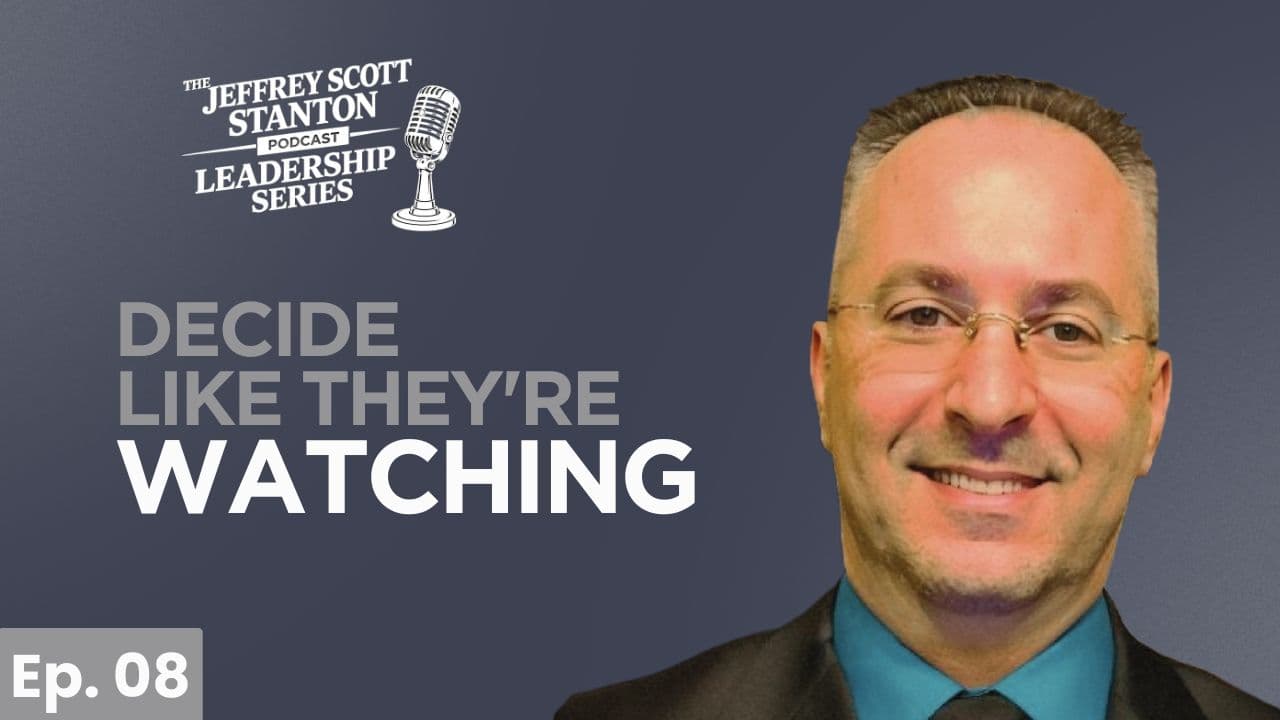
Episode 8 of The Leadership Series is built on Chip and Dan Heath's Decisive, and it opens with the idea most leaders have never been told: a decision is not a private act.
Your Team Reverse Engineers Every Decision You Make
Every choice a leader makes is observed, interpreted, and worked backwards by the people they lead. The team takes the decision and reverse engineers it to figure out what the leader actually values — not what they say they value, but what they protect when protecting it costs something.
"Your team does not just watch the decision. They reverse engineer it."
— Jeffrey Scott Stanton
This is why the culture speech and the decision record eventually diverge in every organization, and why the team always believes the decision. The decision is what is real. Jeffrey drives the point home with two contrasting stories: Karen, whose one fast decision under pressure taught her team exactly how to hold her hostage going forward — and Paul, whose disciplined, unglamorous decision signaled more about his judgment than any hire could have.
The Four Traps
The Heath brothers' research identified four villains that cause smart, experienced people to make predictably bad decisions. Jeffrey is careful about the framing: these are not signs of weakness. They are standard equipment in every human mind, including yours.
Narrow framing. The binary that isn't. Do I fire this person or keep them? Do I take the deal or walk? The trap closes before the thinking even begins, because the frame arrived with only two options in it. Jeffrey walks through a promotion story where all four traps show up in a single conversation — and the counter-move, the Heaths' vanishing options test: if both of the options in front of you disappeared, what would you do? The question forces the mind to generate options it had stopped looking for. One team leader in the episode found the third option that neither original choice contained.
Confirmation bias. A preference hardens into certainty, and the search for disconfirming evidence quietly stops. The fix is deliberate reality testing: before a high-stakes decision, go looking for the evidence that proves you wrong. It is the single most valuable and least natural move in the sequence.
"Certainty is not the same as clarity. Under pressure they feel identical."
— Jeffrey Scott Stanton
Short-term emotion. The feeling of the moment makes the decision, then calls itself logic. The tools here are about distance. The Heaths' 10-10-10 test: how will you feel about this in ten minutes, ten months, ten years? And Jeffrey's overnight rule, born from a manager in the episode who very nearly abandoned a loyal agent on the strength of one bad evening. As Jeffrey puts it, the version of you that decides at 9:00 PM after a hard day and the version that decides at 9:00 AM after a restful night is not the same decision-maker. Ending the discomfort is not the same thing as making the right decision.
Overconfidence. The normal human tendency to be far more certain about the future than the future justifies. The answer is not less confidence. It is planning to be wrong: the pre-mortem, where you imagine the decision has already failed and write down why, surfacing the weaknesses you are motivated to ignore — and the tripwire, where you set in advance the specific signal that tells you the decision is going wrong, while your judgment is still clear. You are leaving instructions for the version of you who will be too invested to act.
When There Is No Good Option
Some decisions in brokerage leadership have no clean answer. Every path costs something. Jeffrey's guidance for those moments is not a trick — it is posture. Make the least bad decision cleanly, name the cost honestly, and stand behind it.
"The leaders people trust most are not the ones who make the easy calls. They are the ones who make the hard calls like adults and stand behind them."
— Jeffrey Scott Stanton
WRAP: The Framework in Four Letters
The Heaths compress the whole discipline into WRAP: Widen your options. Reality test your assumptions. Attain distance before deciding. Prepare to be wrong. Four questions to run before any decision that matters — not to slow you down, but to make sure the call you make is yours and not the trap's.
"You're not deciding whether you're right. You're deciding what happens if you're wrong."
— Jeffrey Scott Stanton
The Monday Move: Find Your One Trusted Person
Your Monday Move: before your next significant decision, run it through WRAP on paper. Then do the move Jeffrey closes the episode with — identify the one person in your world who will tell you the truth about your reasoning rather than agree with your conclusion, and put them in the loop before you commit. Finding that person may be the most important decision-making move you make this year, because every trap in this episode thrives in a mind that deliberates alone.
Listen & Watch the Full Episode
Jeffrey Scott Stanton breaks down the four decision traps and the WRAP framework on The Leadership Series. Available on YouTube and all your favorite audio platforms — Apple Podcasts, Spotify, Amazon Music, and more. New episodes every Wednesday.
About Jeffrey Scott Stanton
Jeffrey Scott Stanton is a Master NLP Practitioner, Behavioral Strategist, and Executive Advisor. Former EVP of Learning & Development at Douglas Elliman Real Estate. He hosts The Leadership Series on J Squared Podcast Productions, a leadership academy in podcast form built for brokers, managers, and high performers responsible for results through others.
- Website: jeffreyscottstanton.com
- LinkedIn: linkedin.com/in/jeffreyscottstanton
Listen to this episode
Work With JMan
Bring this energy to your team or event.
JMan speaks, trains, and builds AI strategies for businesses that want to move faster. See how he can help yours.
Visit jmanai.com →