From Fortune 500 to Founder: Why Staying Comfortable Is the Biggest Career Risk
Most organizations treat change management as a line item to cut when budgets get tight. The result is predictable: expensive transformation initiatives that stall, burn out employees, and leave leadership wondering what went wrong.
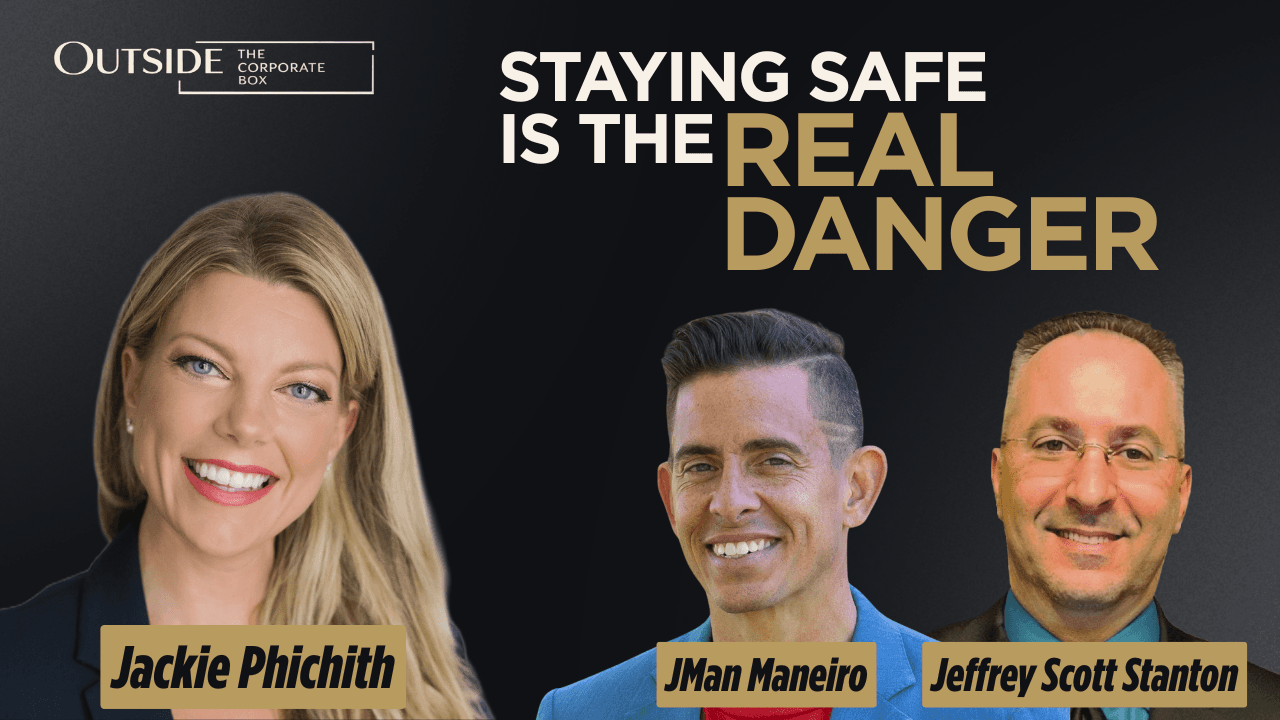
Jackie Phichith spent nearly two decades inside Fortune 500 companies — including McDonald's, Merck, and Pfizer — watching this pattern repeat across industries. Then she stepped outside the corporate box herself, founding Inspiration Your Way and applying the framework she had taught organizations to her own reinvention. On this episode of Outside the Corporate Box, she shared the data, the framework, and the hard-won lessons that explain why change keeps failing and what leaders can do differently.
The Statistic Every Executive Should Lose Sleep Over
According to research Jackie cites from the Harvard Business Review, 70% of enterprise-wide transformations fail. That is not a marginal miss. That is failure as the default outcome. And yet most organizations continue to approach major change with the same playbook: announce it, assign a project team, and expect people to adapt on their own.
The problem runs deeper than poor execution. Jackie points to a separate survey in which employees were asked how qualified they felt their leadership was to guide them through a major transformation. Only 27% said their leaders were ready. Nearly three out of four employees begin a change initiative without confidence in the people leading it.
"The first thing they cut, especially during transformations, is training and professional development. And the reality is an organization is a construct of people working on a unified mission. So by cutting the cost for supporting the people, you're actually setting yourself up for failure."
— Jackie Phichith
Change Is No Longer an Event. It Is the Operating Condition.
Ten years ago, the average enterprise managed roughly two major transformations per year. Today, that number has climbed to ten. With AI accelerating the pace further, change is no longer a periodic event organizations recover from. It is permanent.
That shift creates a specific kind of organizational fatigue. Employees who have lived through failed change initiatives carry that memory into the next one. They have heard the announcement, seen the rollout stumble, and watched leadership quietly move on without acknowledgment. That accumulated experience becomes distrust, and distrust makes the next transformation harder before it even starts.
"You cannot look at employee engagement scores and think that means nothing if it's low. You have to look at that and say, I need to prioritize this."
— Jackie Phichith
The SHINE Framework
Jackie developed the SHINE framework as a structured approach to moving people through change at any scale — from a solo founder managing internal transitions to an enterprise team navigating a full reorganization.
- S — See It: Help people understand what is actually happening. Fear is a reaction to uncertainty. When leaders name the change clearly and explain the reasoning, they strip that fear of its control.
- H — Honor the Shift: Acknowledge the identity transition that change requires. People are not resisting the new system. They are grieving the old one.
- I — Initiate Action: Readiness is not something people wait to feel. It is something they build through momentum.
- N — Navigate Together: The teams that move through transformation best are the ones where people feel safe saying they are struggling.
- E — Elevate: When an organization successfully moves through change together, the team that emerges is stronger than the one that started.
What Teddy Roosevelt's Midnight Rambles Teach Modern CEOs
Jackie draws an unexpected parallel to one of Teddy Roosevelt's early management experiments. When Roosevelt became president of the New York City Police Commission in the 1890s, he found a department riddled with corruption and low accountability. His response was to disguise himself in a coat and hat and walk the city at midnight to see which officers were actually at their posts.
The Midnight Rambles worked not just as accountability enforcement, but as trust building. Officers who saw their commissioner showing up in person and taking the work seriously responded accordingly. The lesson for today's executive is not to conduct surprise inspections. It is to close the gap between what leadership assumes is happening at the ground level and what is actually happening. Many transformations fail because decisions are made with watered-down information by people too far removed from the daily reality of their teams.
Applying the Framework to Your Own Leap
Jackie's expertise is not limited to large organizations. In her own transition from a nearly 20-year corporate career to founder, she found herself applying the same framework she had taught to others. She was the organization. She was the team. And she was the one who needed to move through change.
Her most practical advice for solo founders and small team leaders comes down to structure. Run a quarterly business review on yourself. Build a time-bound strategy with milestones so the doubt in your internal dialogue has something concrete to argue against. Treat your own business with the same operational rigor that corporations apply to theirs.
"The bigger risk wasn't leaving. It was staying comfortable."
— Jackie Phichith
Key Takeaways
- Seventy percent of enterprise transformations fail, and the single most common cause is underinvestment in the human side of change.
- Employee engagement scores are business performance data. Low scores before a transformation predict failure during it.
- The SHINE framework gives leaders and founders a repeatable process: See It, Honor the Shift, Initiate Action, Navigate Together, Elevate.
- Leaders who close the gap between executive decisions and ground-level reality dramatically improve their odds.
- The same change management principles that work inside Fortune 500 companies apply to solo founders managing their own transitions.
Listen & Watch the Full Episode
Jackie Phichith shares the full SHINE framework, the Teddy Roosevelt story, and what she would go back and tell herself on day one — on Outside the Corporate Box. Available on YouTube and all your favorite audio platforms — Apple Podcasts, Spotify, Amazon Music, and more. New episodes every Monday.
About Jackie Phichith
Jackie Phichith is a change management strategist, keynote speaker, and founder of Inspiration Your Way. She brings nearly 20 years of experience from inside Fortune 500 companies including McDonald's, Merck, and Pfizer, where she helped organizations navigate large-scale transformation initiatives. She is the creator of the SHINE framework and now works with leaders and founders across industries to build more human-centered approaches to change.
- LinkedIn: linkedin.com/in/jacquelinephichith
Listen to this episode
Free Download
Want AI doing the heavy lifting while you build your thing?
JMan's free starter kit for business owners: marketing, customers and competitors, with every prompt ready to copy.