The Conversation You Have Been Avoiding Is Already Costing You
There is a conversation you have not had yet. You already know which one. It arrived in your mind before you even finished reading that sentence. You have been carrying it for days, possibly weeks, possibly longer. You have rehearsed it on the drive in. You have told yourself you are waiting for the right moment.
And while you have been waiting, the situation has been running without you. The behavior you have not addressed has been teaching everyone around you what you will accept. The standard you have not reinforced has been softening. The person you have not spoken to directly has been filling every gap you left open with their own interpretation of what it means.
Listen to the full episode on Buzzsprout, Apple Podcasts, Spotify, and all major audio platforms.
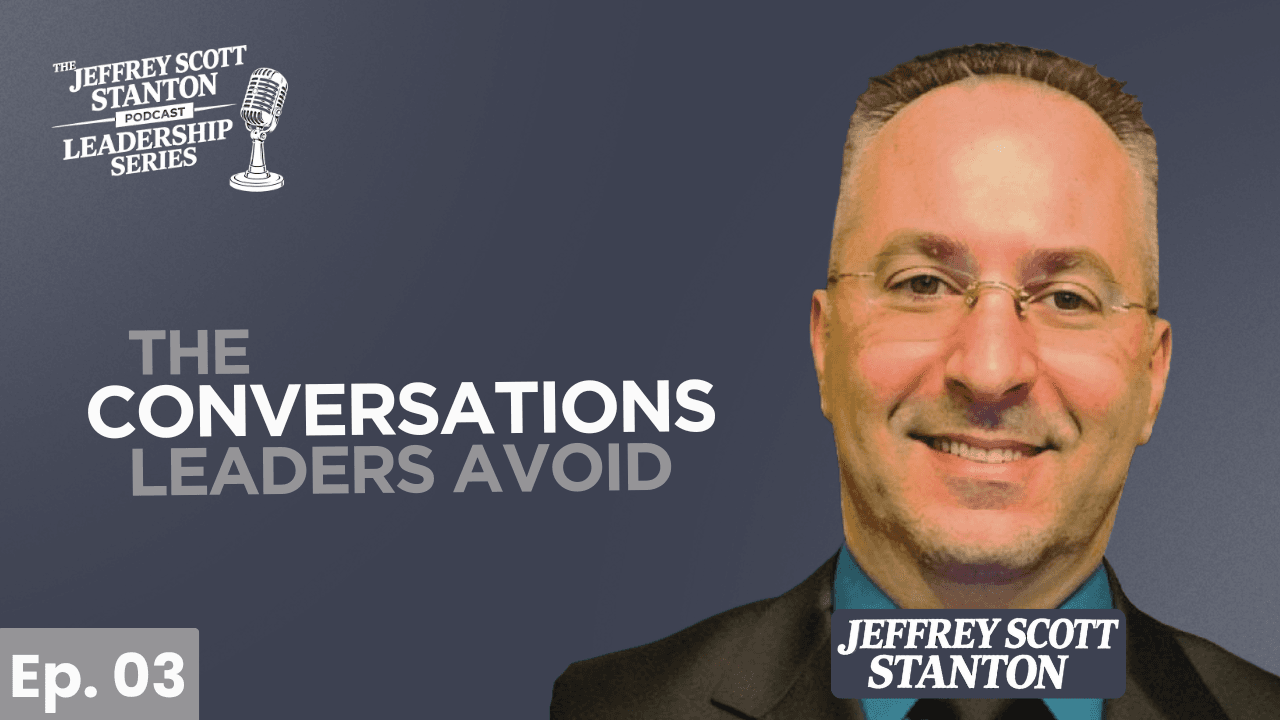
That is the opening of Episode 3 of The Leadership Series, and it is one of the most direct and practically useful episodes Jeffrey Scott Stanton has recorded. Where Episode 1 established leadership as influence and Episode 2 defined vision as the leader's responsibility for direction, Episode 3 takes on the thing that tests both: communication under pressure, specifically the conversations most leaders keep finding reasons to delay.
What Makes a Conversation Crucial
Jeffrey draws from one of the most widely respected books on high-stakes communication, Crucial Conversations by Kerry Patterson and colleagues, to set the framework for this episode. A crucial conversation is defined by three conditions occurring simultaneously: the stakes are high, opinions differ, and emotions are strong. When all three are present, most people stop communicating effectively and start communicating defensively.
What makes this framework valuable is not the dramatic situations it describes. It is the quiet ones. The agent whose numbers have been drifting for three months. The top producer who cuts corners but closes deals, so nobody says anything. The team leader promoted six months ago who is still operating like an individual contributor and has never been told directly that something needs to change.
These conversations feel less urgent than they are. And that feeling is precisely what makes them the most dangerous conversations in any organization.
"The quality of a leader's culture, their team performance, their own credibility — it all traces back more directly to how well they handle these conversations than to almost anything else."
— Jeffrey Scott Stanton
The Fool's Choice: Why Leaders Talk Themselves Out of Hard Conversations
Jeffrey names a concept he calls the Fool's Choice, the false binary that leaders construct in their own minds before any difficult conversation happens. It goes like this: either I address this and damage the relationship, or I stay quiet and protect the relationship. Either I say something and risk losing the person, or I keep the peace and tolerate the behavior.
It sounds like a real choice. It is not. It is a trap.
He illustrates it with a situation most brokers will recognize. A four-year agent with a strong relationship has developed a habit of talking over newer team members in meetings, dismissing their ideas, and quietly undermining their confidence. The broker notices. The team notices. Nobody says anything because the production is there and the relationship feels worth protecting.
But the silence is not maintaining stability. It is building something underneath the surface. The newer agents are learning that production protects behavior. Mid-level agents are recalibrating what the office actually stands for. And the relationship the leader is trying to preserve is already changing, because the agent on the other side is learning without being told that there are no real standards in this organization.
"Silence isn't a form of kindness. It's just a slower form of damage."
— Jeffrey Scott Stanton
The right question, Jeffrey argues, is never whether to say it. It is how to say it in a way that serves both the relationship and the standard. Leaders who develop this skill consistently find that honest, well-executed conversations do not damage relationships. They deepen them.
What Accumulates While You Wait
Most leaders significantly underestimate the cost of delay. Jeffrey breaks it down across three dimensions.
On the leader's side, resentment builds quietly. They become shorter in hallway interactions, less generous with recognition, slightly edged in how they respond in meetings. They are communicating something. Just not clearly, and not the right thing.
On the other person's side, assumptions fill the silence. People almost always sense when something is off. When they have not been told directly what the issue is, they construct their own explanation. That explanation is almost never more accurate or more generous than reality. The leader will find out when the conversation becomes a resignation.
And across the team, drift. Everyone sees a situation that no one is naming. They draw their own conclusions about what the standard actually is. By the time the original conversation finally happens, the leader is no longer managing the original issue. They are managing everything that accumulated around it.
Jeffrey gives a specific example. An agent's production starts slipping. The broker sees it in month one and says nothing. In month two, they mention it generally in a sales meeting: everyone needs to focus on pipeline. The agent nods. Nothing changes. By month five, the broker is frustrated, the agent senses something is wrong but does not know what, and what could have been a thirty-minute coaching conversation in January has become a performance review in June, with the agent heading toward the door.
"The delay didn't postpone the conversation. It changed what the conversation had to be and removed most of the options that existed when the problem was small."
— Jeffrey Scott Stanton
The Why Trap: Waiting for Permission to Have the Conversation
Most leaders do not choose to have difficult conversations. They get forced into them. A deal falls apart. A client complains. A public moment in a team meeting suddenly creates the justification for addressing what should have been addressed months earlier.
The problem with event-triggered conversations is that the event becomes the subject instead of the pattern. The leader addresses the one lost listing when the actual issue has been six months of poor preparation, inconsistent follow-through, and missed standards. The incident gets resolved. The pattern continues.
Jeffrey offers a simple reframe for leaders who want to break this pattern: regularly ask yourself what you would wish you had said six months from now, and then say it today. The best time to have the conversation was earlier. The second-best time is right now.
Creating Safety: The Condition That Determines Whether the Message Lands
Once a leader decides to have the conversation, the most common mistake is walking in without creating safety first. Jeffrey is careful to distinguish safety from comfort. A difficult conversation should not be made comfortable. But it does need to feel safe, meaning the other person can actually receive what is being said without shutting down, fighting back, or nodding along while absorbing nothing.
He describes what walking in without safety looks like in practice. A broker calls a team leader in and opens with: I have been watching the numbers and I am concerned about the direction things are heading. Technically accurate. Completely direct. And the team leader's nervous system immediately starts running a different conversation: am I being fired? Should I call my attorney? What does my agreement say?
That second conversation has taken over. The leader thinks the meeting went well. The team leader heard almost nothing that was intended.
Two elements create safety. The first is mutual purpose: the other person needs to genuinely believe this conversation is happening because the leader cares about their success, not because the leader is managing a problem or building a case. The second is mutual respect: the moment someone feels talked down to or dismissed, the conversation is functionally over even if both people are still in the room.
Jeffrey introduces a tool he calls the contrast statement: naming what you are not saying alongside what you are actually saying. Something like: I am not here to tell you your future is in question. I am here because I think you are capable of more than what I have been seeing, and I want to understand what is getting in the way. That one move closes the door on the interpretation that would shut the other person down before the real conversation can begin.
The Meaning of Communication Is the Response You Get
Jeffrey draws on a principle from neuro-linguistic programming that he returns to consistently in his leadership coaching: the meaning of communication is the response you get, not the response you intended.
When a message does not land the way you intended, the responsibility for that belongs to the communicator, not the receiver.
The default position for most leaders when this happens is: I told them clearly. They should have understood. That position produces nothing useful because it locates the problem somewhere the leader has no control over. The more productive question is: how do I need to communicate this differently so the response I get is the one I need?
"The meaning of communication is the response that you get. Not the response you intended. Not the response you thought the words deserved. The response you actually get."
— Jeffrey Scott Stanton
This reframe is uncomfortable, Jeffrey acknowledges, because it requires staying curious about your own role in the breakdown instead of explaining it away. When an agent did not change their behavior after a conversation, this principle says something about how the conversation was delivered, not about the agent's willingness to improve. Maybe the relationship was not safe enough for them to receive the message. Maybe the expected outcome was not specific enough to act on. Maybe they heard the words but not the urgency behind them.
Listening Past the First Answer
Jeffrey makes a point that applies as directly to sales as it does to leadership: in a high-performance environment, people are trained to present with confidence. An agent will tell you the market is slow when their pipeline is empty because they stopped prospecting. A team leader will tell you the team is aligned when what they mean is that people have stopped openly disagreeing, which is not alignment, it is disengagement. A new agent will tell you they are fine while two deals have fallen apart and they are quietly questioning whether they chose the right career.
The habit that separates leaders who catch these signals early is simple: ask one more question before you accept the first answer. When someone says they are fine, ask what fine looks like right now. When someone says it is the market, ask what is still working for them in this market. Stay curious long enough to reach the real version of what they are saying.
Paired with this is the practice of paraphrasing — not repeating back what someone said word for word, but restating it in your own words to confirm your understanding and give them the chance to correct you. The moment someone responds with well, not exactly, what I meant is, they have just told you something they would not have said otherwise. That is the real information. And real information is what changes what you lead.
When Pressure Hits: Two Things That Actually Help
Everything covered in this episode — safety, contrast statements, the meaning of communication, real listening — all of it disappears the moment pressure spikes if it has not been built through practice. Under pressure, people default to the pattern they are most comfortable with. The leader who understands these ideas intellectually but has not practiced them will feel the tension rise and watch the framework evaporate.
Jeffrey shares a moment from his own experience: a senior agent he respected challenged a decision he had made in a full team meeting. The room went quiet. His instinct was to defend, to assert authority, to shut it down in front of everyone. What he did instead was ask a simple question: tell me more about what concerns you.
Not because he was calm. Because he had learned from situations he had handled worse. What the room needed at that moment was not for him to be right. It was for him to be trustworthy. What came out of that question was a legitimate concern about a detail he had not fully considered. He acknowledged it. They adjusted. That agent became one of the most loyal and aligned he ever worked with.
He offers two specific tools for pressure moments:
- Slow down physically when the conversation speeds up emotionally. The pause between what just happened and what you do next creates enough space for clarity to enter.
- When you feel defensive, ask a question instead of making a statement. Tell me more about your concern. Help me understand where you are coming from. That shift signals something more powerful than any answer you could give: you are more interested in the truth than in winning the moment.
The Monday Move: Four Things to Write Down Before You Walk In
Your Monday Move: Before you have the conversation you have been carrying, write down four things.
- What is the specific behavior or situation that needs to be addressed?
- What is the concrete outcome you want when it is over?
- What is the second conversation likely to be — what conclusion will they probably draw the moment you open this topic?
- What is your contrast statement — what are you not saying, alongside what you are actually saying?
That is your anchor. Not a script. An anchor. Then go have the conversation.
Listen to the Full Episode
Jeffrey Scott Stanton takes on the conversations most leaders keep finding reasons to delay on The Leadership Series. Available on Apple Podcasts, Spotify, Amazon Music, and all major audio platforms. New episodes every Wednesday.
About Jeffrey Scott Stanton
Jeffrey Scott Stanton is a Master NLP Practitioner, Behavioral Strategist, and Executive Advisor. Former EVP of Learning & Development at Douglas Elliman Real Estate. He hosts The Leadership Series on J Squared Podcast Productions, a leadership academy in podcast form built for brokers, managers, and high performers responsible for results through others.
- Website: jeffreyscottstanton.com
- LinkedIn: linkedin.com/in/jeffreyscottstanton
Work With JMan
Bring this energy to your team or event.
JMan speaks, trains, and builds AI strategies for businesses that want to move faster. See how he can help yours.
Visit jmanai.com →