The Most Dangerous Moment in Your Leadership Is the Three Seconds Before You Respond
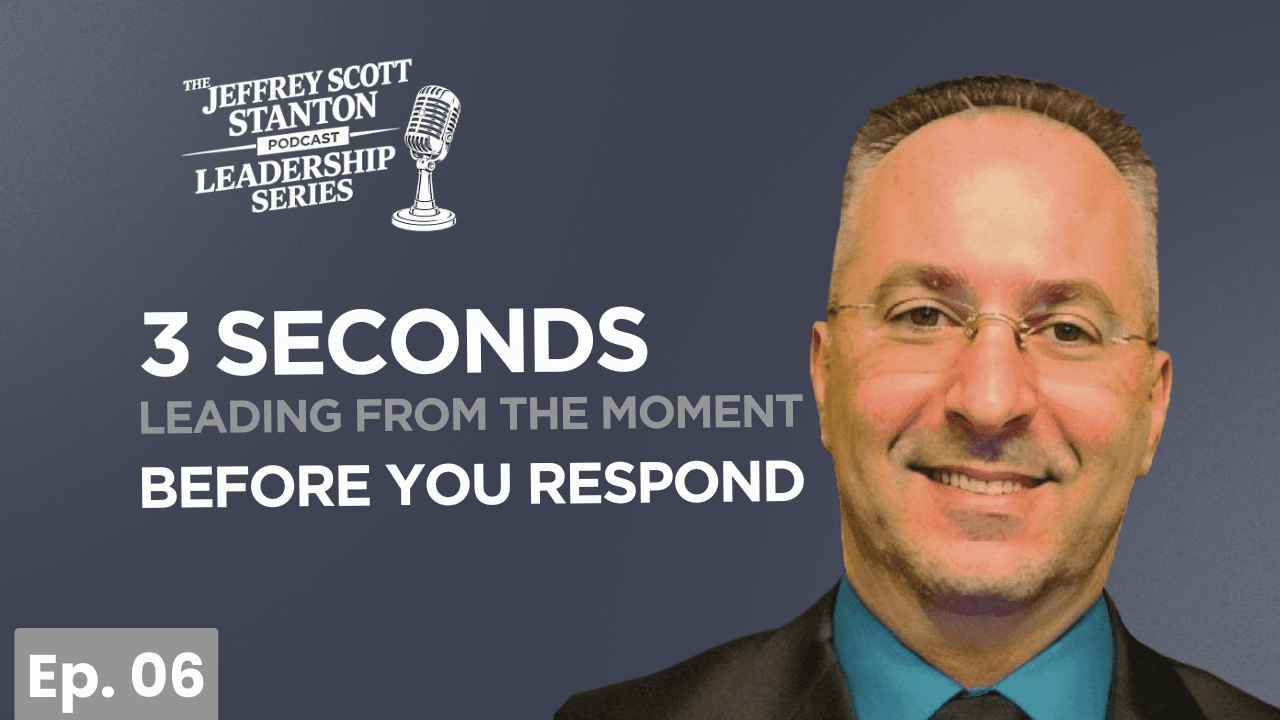
The most dangerous moment in your leadership is not when things go wrong. It is the three seconds before you respond.
Episode 6 of The Leadership Series takes on the force that operates inside those three seconds. Drawing on Harvard psychologist Susan David's work in Emotional Agility, Jeffrey Scott Stanton unpacks one of the least discussed and most consequential skills in leadership: what happens between the trigger and your response, and why the leaders who appear most composed are often the last to understand the damage their patterns are creating.
Episode 1 named the principle: leadership is not about being emotionless, it is about being regulated. This episode does the work.
What It Means to Be Hooked
Susan David's central concept is the hook: the moment an emotion takes over your response before any real decision gets made. A hooked leader is not choosing. They are executing the emotion's instructions — the sharp reply, the defensive explanation, the silence that fills the room — while believing the whole time that they are exercising judgment.
The version of the hook most dangerous for high performers is what David calls cognitive fusion: being hooked not by a feeling but by a thought. The certainty that you are right. The conviction that the other person is the problem. Cognitive fusion is dangerous precisely because it does not feel like an emotion at all. It feels like good judgment. And the more successful a leader has been, the more their certainty has been rewarded, which makes the fusion harder to spot from the inside.
A hooked leader also pays an invisible tax: the room starts pre-filtering the truth. People learn which topics trigger the reaction and quietly route around them. The leader hears less and less of what they most need to know, and never notices the silence forming.
Suppression Is Not Regulation
Most leaders, when they recognize an emotional reaction rising, do the thing they have been implicitly trained to do: push it down. Stay composed. Keep the face neutral. Get through the meeting.
The research Jeffrey walks through says suppression accomplishes almost the opposite of what it intends. Pushing an emotion down intensifies it. It degrades decision quality while the suppression is happening. It leaks — other people register that something is off even when the leader is certain nothing is visible. And it releases later, at higher intensity, usually at someone who did not cause it.
Jeffrey illustrates the cost with the story of Sandra, a leader whose quiet suppression looked like composure from the outside. It took 18 months for the invisible barrier it created between her and her team to surface. Nobody could name what was wrong. Everybody felt it.
Regulation is a different mechanism entirely. It is a practiced skill of noticing and naming what you are feeling without being governed by it. From the outside, suppression and regulation can look identical — both look calm. From the inside, one is a pressure cooker and the other is a choice.
Your Emotional State Is Contagious Before You Say a Word
The stakes get higher when you understand the transmission mechanism. Through mirror neurons, a leader's emotional state is picked up and mirrored by the people around them before anyone speaks. Walk into a meeting hooked, and the room is hooked with you. The anxiety you believe you are hiding is already circulating.
This is why emotional agility is not a personal wellness topic. It is an organizational variable. The internal state of the leader becomes the operating climate of the team, one meeting at a time.
The Four Moves of Emotional Agility
The heart of the episode is Susan David's four-move sequence, translated into leadership practice.
Show Up. Notice that you are being hooked. Not judging it, not fixing it. Just: I am feeling something. There is a hook here.
Step Out. Create distance between you and the emotion using the labeling technique: I am noticing anger instead of I am angry. The research behind this is striking — naming an emotion in this way measurably reduces its intensity within seconds. You are no longer inside the feeling. You are observing it.
Walk Your Why. The most underestimated move of the four. Ask yourself: what do I value most in this interaction? Not what would feel satisfying. What you value. Jeffrey's point is that once that question is genuinely asked, the response almost always chooses itself.
Move On. Take the action. Have the conversation. Make the decision — from intention rather than reaction, from values rather than the hook.
Jeffrey pairs the framework with the story of Thomas, a leader who spent four months of imperfect practice building a different relationship with the hook that had been running him. Four months, not four days. The three seconds are trainable, but they are trained through repetition, and the leaders who improve fastest are the ones who find someone willing to tell them the truth about their patterns — because high performers are reliably the worst at self-assessing this particular skill.
"The most dangerous moment in your leadership is not when things go wrong. It's the three seconds before you respond. Those three seconds are trainable."
— Jeffrey Scott Stanton
The Monday Move: Name Your Hooks Before You Walk In
Your Monday Move: First, name your specific hooks — not emotional reactions in general, but the exact situations that most reliably pull you out of your best leadership. Second, identify one high-stakes interaction coming in the next 30 days where your hook is most likely to appear. Third, before you walk in, answer one question: what do I value most in this interaction? Write it down if it helps.
When the hook arrives — and it will — the Walk Your Why move is already done.
Listen & Watch the Full Episode
Jeffrey Scott Stanton breaks down emotional agility and the three seconds that define your leadership on The Leadership Series. Available on YouTube and all your favorite audio platforms — Apple Podcasts, Spotify, Amazon Music, and more. New episodes every Wednesday.
About Jeffrey Scott Stanton
Jeffrey Scott Stanton is a Master NLP Practitioner, Behavioral Strategist, and Executive Advisor. Former EVP of Learning & Development at Douglas Elliman Real Estate. He hosts The Leadership Series on J Squared Podcast Productions, a leadership academy in podcast form built for brokers, managers, and high performers responsible for results through others.
- Website: jeffreyscottstanton.com
- LinkedIn: linkedin.com/in/jeffreyscottstanton
Listen to this episode
Work With JMan
Bring this energy to your team or event.
JMan speaks, trains, and builds AI strategies for businesses that want to move faster. See how he can help yours.
Visit jmanai.com →