The Standard You Haven't Enforced Is Already Running Your Organization
There is a standard you have not enforced yet. You know exactly which one. Something happened, you saw it, you felt what it meant, and then you let it go. The behavior continued. Your stated expectations softened. And every person who witnessed that moment registered what just happened, even if nobody said a word.
In that moment, the real standard changed. Not the one you talk about. The one that actually governs your organization.
Listen to the full episode on Buzzsprout, Apple Podcasts, Spotify, and all major audio platforms.
Episode 4 of The Leadership Series picks up where Episode 3 left off. Communication, Jeffrey Scott Stanton argued, is only as powerful as what it anchors to. That anchor is standards. And whether those standards are real or just statements is the most important measurement in any organization.
This episode draws from Jim Collins' foundational research in Good to Great, which found that what separates organizations that make the leap from good performance to genuinely great performance is not strategy, charisma, or market conditions. It is discipline. Disciplined people making disciplined choices in a consistent direction over time.
Two Sets of Standards Are Always Operating
In every organization, two sets of standards operate simultaneously. The stated standards are what leaders communicate, what is written in onboarding materials, what gets announced at kickoff meetings, what is posted on the wall. The real standards exist somewhere else entirely: in what actually gets tolerated, who gets held accountable and who does not, and what happens or does not happen when someone falls short.
The real standards always win.
People are not reading mission statements. They are reading the leader, in small moments, every day. They are constantly updating their understanding of what the actual rules are based on what they observe, what gets rewarded, what gets ignored, and what gets quietly passed by. Their behavior adjusts to match those observations, not the language on the wall.
"The difference between what you say you stand for and what you actually enforce is the most important measurement in your organization."
— Jeffrey Scott Stanton
Jeffrey illustrates this with a scenario leaders will recognize immediately. A clear expectation is set: respond to clients within two hours. Three of the strongest performers on the team routinely take five or six hours to respond. Nothing happens. No conversation, no follow-up, no consequences. Within a month or two, the entire team has quietly renegotiated that standard to whatever feels reasonable individually, because they watched the gap between what was said and what was enforced and drew the only rational conclusion available to them: the standard does not actually mean what it says.
Culture Drift: How Standards Erode Without Anyone Deciding They Should
Jeffrey introduces the concept of culture drift, the process by which an organization's real standards quietly shift away from its stated ones through the accumulation of small, individually defensible decisions.
One exception was made because the timing was difficult. One moment got filed away as something to address later, and never was. One situation where the relationship felt more important than the standard. Each of those decisions feels reasonable on its own. Compounded over months, they are quietly rewriting what the organization actually stands for.
The psychological mechanism behind this pattern is called status quo bias: the natural tendency to prefer the current state of things over the discomfort of changing it. When a standard is violated, the confrontation feels risky, the situation is uncomfortable, and the mind looks for a way to reduce tension. The path it finds is: let it go this time. The relief of avoiding that discomfort is immediate. The cost is invisible in the moment.
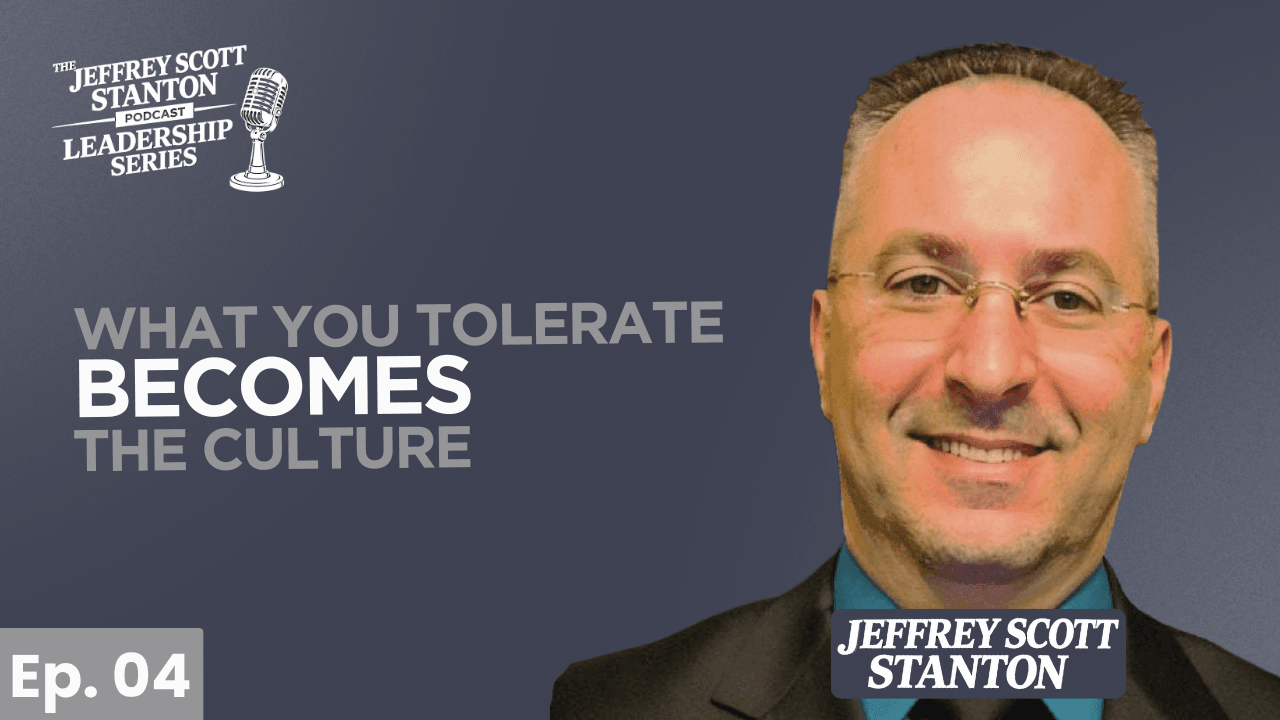
"What you tolerate becomes the culture. Not what you write down. Not what you announce. What you tolerate."
— Jeffrey Scott Stanton
The hardest part of recognizing culture drift from inside an organization is that it almost never feels dramatic when it is happening. It feels small. It feels like leadership. The leaders Jeffrey has watched go through this realization were ones who worked hard and genuinely cared about what they were building. The moment of recognition, he notes, is one of the loneliest experiences in leadership, because there is no single decision that caused it.
Performance Exemption: The Most Structurally Destructive Leadership Mistake
The most expensive version of culture drift is what Jeffrey calls performance exemption: the unspoken organizational belief that high performers operate under a different set of rules, that standards apply to everyone except the people whose output makes them too valuable to confront.
Leaders do not create this exemption out of laziness or indifference. They are holding two competing values in tension: the standard on one side and the relationship, revenue, or stability that person represents on the other. The exemption is the mind's resolution to that tension. It removes the discomfort immediately. Jeffrey is clear: it is not weak, it is human. But it is still wrong, and it operates on three levels simultaneously.
First, what it does to the person being exempted. When a high performer learns through a leader's behavior that their output protects them from the standard, something shifts in how they experience the organization. They stop seeing it as somewhere they belong and start seeing it as a platform they perform on. The relationship becomes transactional. A transactional relationship ends the moment a better transaction appears.
Second, what it does to everyone else. When the team sees that production creates exemption, they draw two conclusions simultaneously. These standards are not real. And, more personally: does my own output make me valuable enough to be protected here? That internal calculation is a retention crisis developing in plain sight.
Third, what it does to the people a leader has not yet recruited. High-character, high-performing professionals are drawn to environments where standards are genuinely real. They feel the culture before anyone explains it to them. If the standards are not real, a leader will keep attracting people who need the exemption and lose the ones who do not.
"People do not leave leaders who hold them to a standard. They leave when the leader holds different standards for different people, because that exception does not feel like protection. It feels like the leader does not believe in them enough to actually lead them."
— Jeffrey Scott Stanton
The Story of Maya: What Waiting Costs
Jeffrey shares the story of a leader he worked closely with, a sharp, experienced manager running a high-performing sales team. She had one person whose results were consistently the strongest in the group: strong numbers, visible in the market, respected externally. Internally, that person operated alone, made unilateral decisions, bypassed processes regularly, created friction, and generated more work for everyone around them.
Maya knew exactly what was happening. She was not in the dark. She would sit in her office after a difficult week and draft the conversation in her head, know exactly what needed to be said. Then Monday would arrive with a new listing or two, and a different voice would surface: look what they just produced. Is now really the right time?
There was always a reason the timing was not quite right. Every week she waited, she told herself she was being thoughtful. What she was actually doing was choosing the comfort of not having the conversation over her responsibility as a leader.
Three of her strongest developing team members left within months, not for better compensation or a better title. In their exit conversations, they said they wanted to be somewhere where expectations actually meant something equally for everyone. The exemption they observed told them everything they needed to know about whether this organization's culture was real.
Maya eventually had the real conversation: direct, specific, with clear expectations and real consequences attached. The high performer did not leave. They adjusted. Within six months, they had become a more consistent producer and were operating in alignment with the team and the organization's culture. Because someone had finally cared enough to be honest with them about what was not working.
Three Things a Standard Needs to Stay Real
Understanding why standards matter is one thing. Building ones that hold up when they are tested is another. Jeffrey identifies three components that separate standards that stick from standards that erode.
The first is behavioral clarity, not conceptual clarity. Saying you expect professionalism is a conceptual standard. Everyone nods. Everyone defines it differently. When it is violated, there is nothing specific to point to. Compare that to: we return phone calls within two hours, we arrive prepared and on time for every meeting. Those are behavioral standards. They describe what the expectation looks like in action.
The second is consistency. Jeffrey cites behavioral research showing that inconsistent reinforcement is actually more resistant to change than behavior that has never been reinforced at all. Every time a leader enforces a standard one week and lets it go the next depending on relationship, timing, or what else is happening, they are not giving themselves a pass. They are actively making the standard harder to hold in the future.
The third is recognition. Most leaders only engage with standards when they are violated. But a standard that only surfaces when something goes wrong eventually becomes associated with punishment rather than identity. The leaders who build the strongest cultures are the ones who name the standard when it is lived up to, specifically and directly. The organization then understands not just what is unacceptable, but what acceptable actually looks like in practice.
"A standard that's clear, consistent, reinforced, and connected to something people believe in stops being a rule. It becomes part of how the organization understands itself. And that shift from rule to identity is where culture actually lives."
— Jeffrey Scott Stanton
Standards as Identity, Not Control
Most leaders think about standards as rules: mechanisms for maintaining order, preventing problems, keeping people in line. That framing is not wrong, but it is incomplete. And when it is the only frame a leader holds, enforcing standards always feels like enforcement. A burden. Something done reluctantly rather than out of belief.
Jeffrey offers a reframe drawn from the Good to Great research. Great organizations found the intersection of three things: what they could be genuinely excellent at, what drove their success, and what they cared about deeply. Every decision, every standard, every expectation existed in service of that intersection. They said no to everything outside of it, no matter how attractive it looked in the short term.
When a leader applies that frame to standards, something shifts. Standards are not about control. They are the expression of what an organization has decided to be excellent at. They protect the thing being built. Holding a standard stops feeling like enforcement and starts feeling like an act of clarity: this is what we are, this is what we do here, this is who we are.
The Flywheel: How a Standard Becomes a Culture
Jeffrey closes the episode with an image from Good to Great that he returns to consistently when thinking about how culture gets built: a massive, heavy flywheel that takes real effort just to begin moving. Each push barely moves it at first. But the leader keeps pushing, in the same direction, consistently. At some point the wheel develops its own momentum, and every push produces more movement than the one before.
That is how a standard-based culture gets built. The first time a behavior is addressed directly when it would normally be let go, there is friction. The first time a commitment is held when someone expects it to bend, there is resistance. The wheel is heavy. Many leaders feel that resistance and conclude that holding standards is not worth the cost. They stop pushing.
The leader who keeps going, who holds the standard every time it matters and recognizes it when it is lived, starts to notice something shift. The resistance decreases. People stop testing the line because they know it will be held. They begin self-correcting before anything needs to be said. New people absorb the standard through the environment itself, not through documents or training or anything written on a wall.
That is the flywheel moving. And once it reaches the point where the standard is being held by the organization rather than only by the leader — where people have internalized it and hold each other to it because it has become part of who they are — that is when culture becomes a genuine competitive advantage.
The Monday Move: Three Diagnostic Questions
Your Monday Move: Walk through your team in your mind. For each person, ask one question:
- Does the standard apply to them the same way it applies to everyone else? Where the answer is no, that is your most significant leadership challenge right now.
- If you stepped away for two weeks with no check-ins, what would happen to your standards? The answer tells you whether you have a culture or a supervision system.
- In the last 30 days, how many times did you specifically name a behavior you observed and connect it directly to a standard? If you cannot remember, you are only reinforcing standards when they are violated. Start naming them when they are lived.
Listen to the Full Episode
Jeffrey Scott Stanton takes on standards, culture drift, and performance exemption on The Leadership Series. Available on Apple Podcasts, Spotify, Amazon Music, and all major audio platforms. New episodes every Wednesday.
About Jeffrey Scott Stanton
Jeffrey Scott Stanton is a Master NLP Practitioner, Behavioral Strategist, and Executive Advisor. Former EVP of Learning & Development at Douglas Elliman Real Estate. He hosts The Leadership Series on J Squared Podcast Productions, a leadership academy in podcast form built for brokers, managers, and high performers responsible for results through others.
- Website: jeffreyscottstanton.com
- LinkedIn: linkedin.com/in/jeffreyscottstanton
Work With JMan
Bring this energy to your team or event.
JMan speaks, trains, and builds AI strategies for businesses that want to move faster. See how he can help yours.
Visit jmanai.com →