Trust Is Not a Feeling. It Is the Currency Your Leadership Runs On.
There is someone on your team who trusts you less than they used to. You may not know when it changed. But the person who used to bring you their real problems stopped bringing them. And they will not tell you.
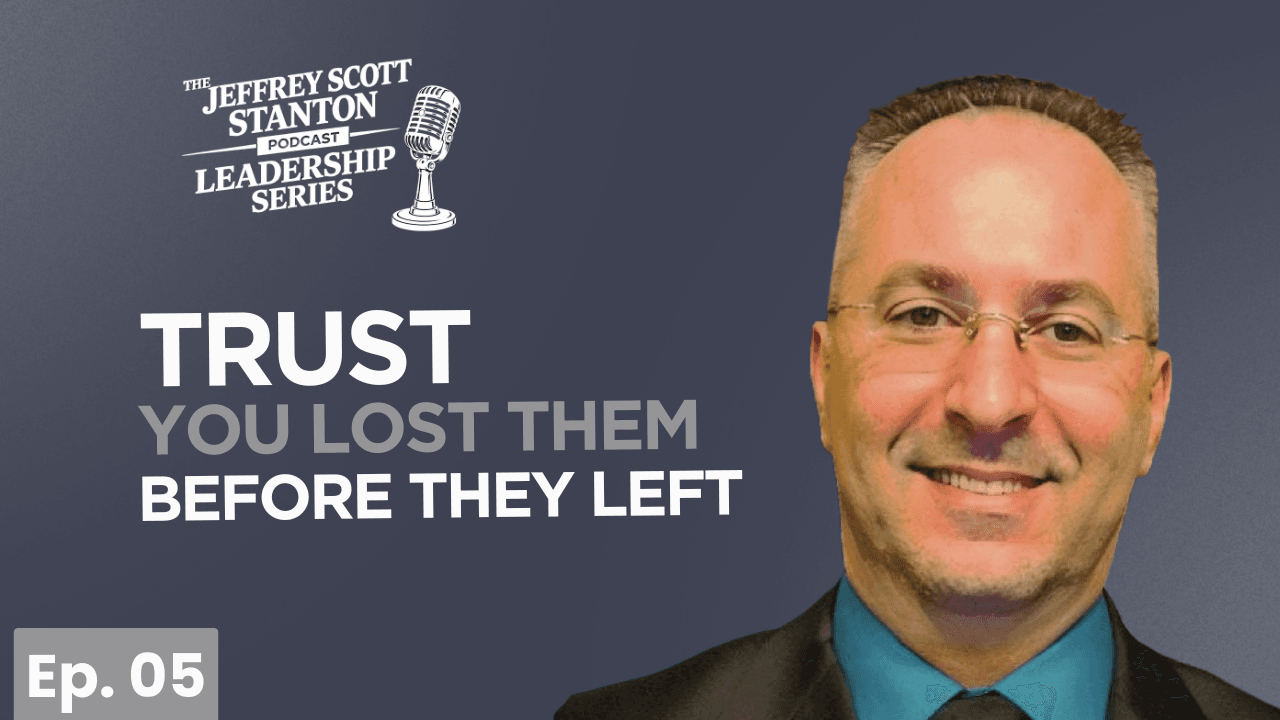
That is the opening of Episode 5 of The Leadership Series, built around Stephen M.R. Covey's The Speed of Trust. And it lands on a premise most leaders have never fully considered: trust is not a soft leadership virtue. It is an economic force. When trust is high, everything in an organization moves faster and costs less. When it is low, people stop bringing you the truth, commitment drops to compliance, and you lose people long before they ever hand in their notice.
The Trust Tax You Are Already Paying
Covey's framework treats trust like a line item that shows up in every interaction, whether you account for it or not. High trust pays a dividend: conversations are shorter, decisions move faster, people take direction without second-guessing the motive behind it. Low trust charges a tax: everything gets re-explained, re-verified, and quietly renegotiated.
Jeffrey grounds this in the neuroscience, drawing on Paul Zak's research on how the brain responds to trust and to social threat. Trust is not a sentiment people choose. It is a neurological state that changes how people think, collaborate, and commit. When someone on your team perceives a threat in how you lead — inconsistency, unpredictability, a gap between what you say and what you do — their brain shifts into protection mode. And a protected brain does not bring you problems. It brings you the word "fine."
"People do not stop trusting you all at once. They just stop bringing you the truth."
— Jeffrey Scott Stanton
Character Trust and Competence Trust Are Not the Same Thing
One of the most useful distinctions in this episode comes straight from Covey's model: trust has two foundations, character and competence. Competence trust is whether people believe you are good at what you do. Character trust is whether they believe you will do what you said, tell them the truth, and act in their interest when it costs you something.
Most high performers have one without the other. And most leaders in real estate were promoted on competence alone. Their production record bought them the title. But competence trust by itself produces compliance — people do what is required and nothing more. Commitment, the kind people give when no one is watching, only comes when character trust is present too.
"Most leaders are leading on borrowed trust. Their competence bought them entry into the room. But it is character that keeps people in it."
— Jeffrey Scott Stanton
The Trust Bank Account
Jeffrey walks through the deposits-and-withdrawals framework that makes trust manageable instead of mystical. Every kept commitment, every direct conversation, every moment of follow-through is a deposit. Every missed commitment, every surprise, every gap between intention and behavior is a withdrawal.
The math is not symmetrical. Because of the brain's negativity bias, one withdrawal costs more than multiple deposits earn. That asymmetry changes how a leader has to operate. You do not get to average out your behavior. The account balance is set by your worst patterns, not your best moments.
"Trust does not break when you fail. It breaks when you say something and do not follow through."
— Jeffrey Scott Stanton
That line deserves a second read, because it separates two things leaders constantly confuse. Your team can absorb failure. Deals fall apart, markets turn, decisions go wrong. What the account cannot absorb is unreliability — the commitment made casually on a Tuesday and forgotten by Friday.
You Are Measuring by Intention. They Are Measuring by Experience.
The most uncomfortable insight in the episode is about measurement. Leaders grade themselves on what they meant to do. The people around them grade them on what actually happened.
"They are measuring by their intentions. The people around them are measuring by what they actually experienced. And those two numbers are almost never the same."
— Jeffrey Scott Stanton
This is why so many leaders are genuinely surprised when a strong agent resigns or a loyal manager disengages. By their own internal ledger, nothing was wrong. But the other ledger — the one that actually governs the relationship — had been drawing down for months.
Repair Starts With Acknowledgment, Not Explanation
When trust has already been damaged, most leaders get the repair sequence backwards. They lead with the explanation: here is why it happened, here is the context you did not see. Explanation offered before acknowledgment reads as defense.
The sequence that works, drawn from trust repair research, runs in a specific order: acknowledgment first, then explanation, then changed behavior, then time. Name what happened and what it cost the other person before you explain anything. Then let consistent behavior do the rest of the work, because after a breach, words have stopped counting.
For new leaders, Jeffrey closes with a practical playbook: four specific moves in the first 30 days that build character trust before competence has had a chance to prove itself — because a new leader inherits the relational history of everyone who held the seat before them, good and bad.
The Account You Are Building Right Now
Your move this week: pick the person on your team who used to bring you their real problems and no longer does. Do not confront them. Just start making deposits — small commitments, kept visibly, repeatedly. The balance you rebuild there is not a favor to them. It is the operating capital of your leadership.
"The account you are building right now is the account you will lead from."
— Jeffrey Scott Stanton
Listen & Watch the Full Episode
Jeffrey Scott Stanton breaks down trust as the economic engine of leadership on The Leadership Series. Available on YouTube and all your favorite audio platforms — Apple Podcasts, Spotify, Amazon Music, and more. New episodes every Wednesday.
About Jeffrey Scott Stanton
Jeffrey Scott Stanton is a Master NLP Practitioner, Behavioral Strategist, and Executive Advisor. Former EVP of Learning & Development at Douglas Elliman Real Estate. He hosts The Leadership Series on J Squared Podcast Productions, a leadership academy in podcast form built for brokers, managers, and high performers responsible for results through others.
- Website: jeffreyscottstanton.com
- LinkedIn: linkedin.com/in/jeffreyscottstanton
Listen to this episode
Work With JMan
Bring this energy to your team or event.
JMan speaks, trains, and builds AI strategies for businesses that want to move faster. See how he can help yours.
Visit jmanai.com →